
Your net worth
Net worth is Accounts + Assets + what’s owed to you − what you owe: everything in your banks and wallets, plus your gold, silver, stocks and the assets you value yourself, with your open debts added or taken off.
You’ll find it in Insights under Net Worth.
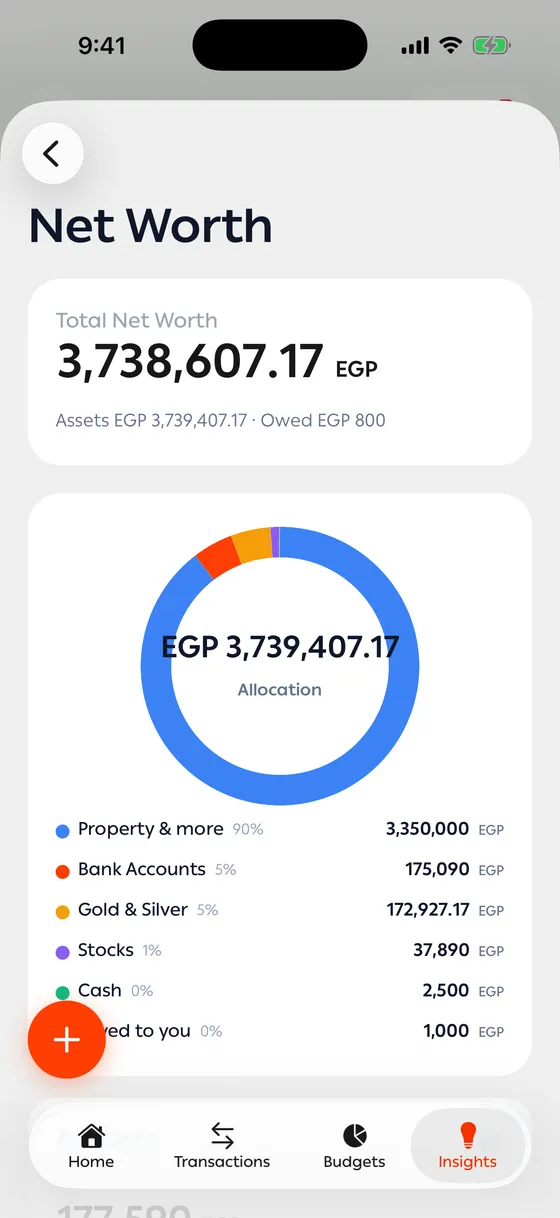
What you see
Section titled “What you see”- Total Net Worth — the whole figure.
- Allocation — accounts against assets, and what share each type holds.
- A breakdown by bank accounts, cash, stocks, and gold and silver.
- Debts — the last card: what’s Owed to you and what You owe, counting only what’s still left on each open debt.
What counts
Section titled “What counts”Every account and every asset has Include in net worth, on by default — except credit cards, which are off, because their balance is credit available rather than money you have.
Turn it off for anything that shouldn’t be in the figure: an account you manage for someone else, or gold you’re holding for a friend.
Debts work the same way with Count in net worth, on by default. Money owed to you adds what’s left to the figure, and money you owe takes it off. Turn it off from the debt’s screen or its form — a loan you don’t expect back, for example. Settled debts don’t count, and the Debts card says how many debts you’ve left out.
- Get your balances right first. Net worth is only as accurate as what sits behind it.
- Look at it monthly, not daily. It moves slowly, and watching it daily only causes worry.
Common problems
Section titled “Common problems”The figure is lower than I expected — an account or asset has its net-worth switch off, or a debt you owe is being counted.
A debt I paid in part is counted in full — only what’s left counts. Check that the payment is recorded on the debt.
My gold isn’t counted — open the asset and check Include in net worth.